Designing Intelligent Agents for Complex Business Ecosystems – Architecture & Governance
Complex business problems demand agents that can reason, adapt, and operate within governed frameworks. This analysis outlines a disciplined approach to agent design and architecture, emphasizing modularity, resilience, and accountability.
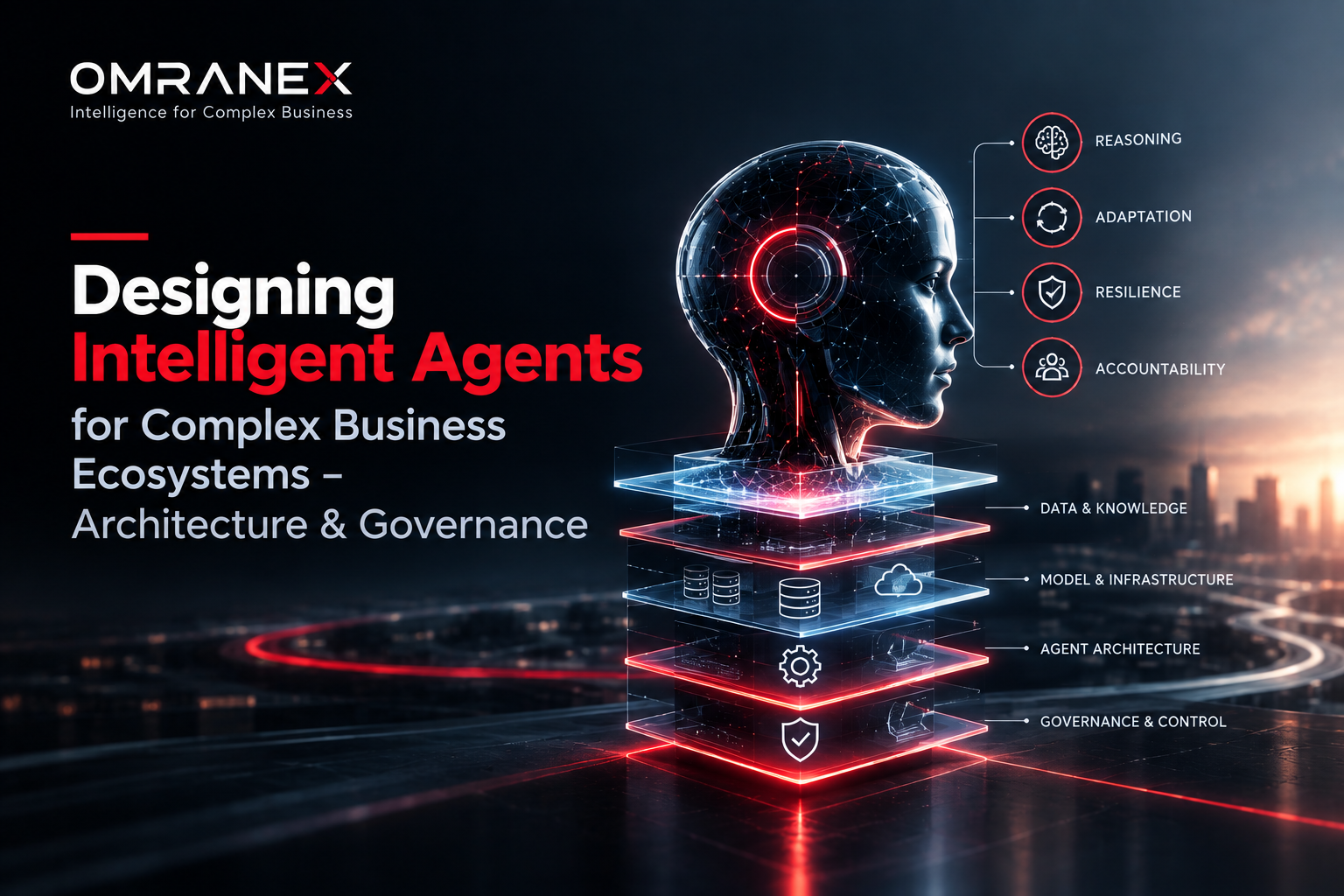
Foundations of Agent Design in Complex Environments
Complex business problems are characterized by interdependent variables, emergent behaviors, and high levels of uncertainty. Traditional rule‑based systems fail when the problem space shifts faster than the model can be retrained. Intelligent agents must therefore embed mechanisms for continuous understanding, adaptation, and governance within a single architecture. The design premise is that each agent is a bounded rational actor that can perceive its environment, reason about alternatives, and act while respecting organizational policies. This triad—perception, reasoning, action—must be implemented as reusable components that can be composed, replaced, or scaled without disrupting the overall system.
Architectural Patterns for Adaptive Intelligence
To address the dynamic nature of complex enterprises, a set of proven architectural patterns provides a scaffold for building resilient agents. The modular microservices pattern isolates functional responsibilities such as data ingestion, feature extraction, and decision inference, enabling independent evolution. An event‑driven architecture supplies agents with a real‑time view of system state changes, allowing rapid response to new information. Hierarchical control layers separate strategic planning from tactical execution, while meta‑learning loops sit atop these layers to adjust model parameters based on performance feedback. Together, these patterns create a system that can self‑optimize while preserving traceability.
- Modular microservices isolate concerns and support independent versioning.
- Event‑driven communication ensures low‑latency awareness of external changes.
- Hierarchical control distinguishes strategic intent from operational actions.
- Meta‑learning loops enable automatic adaptation of predictive models.
- Containerized deployment guarantees reproducibility across environments.
Governance and Trust in Multi‑Agent Systems
Governance is not an afterthought but a core design requirement. Agents must be equipped with provenance tracking, policy enforcement engines, and audit trails that satisfy regulatory and compliance mandates. Trust is established through deterministic behavior under defined conditions, transparent reasoning paths, and verifiable outcomes. Implementing a governance layer involves defining data ownership, setting access controls, and embedding ethical constraints directly into agent decision logic. Continuous monitoring and anomaly detection further reinforce confidence in agent outputs.
Intelligence without governance is a liability; governance without intelligence is a constraint.
Implementation Considerations and Lifecycle Management
From a practical standpoint, the development lifecycle mirrors that of any critical enterprise system. Requirements are captured at the business level, translated into agent capabilities, and validated through unit and integration tests that simulate edge cases. Container orchestration platforms (e.g., Kubernetes) simplify scaling and versioning, while model registries provide immutable snapshots for rollback. Runtime observability—metrics, logs, and distributed tracing—must be baked into the agent framework to support root‑cause analysis. Finally, a structured retraining pipeline ensures that agents remain aligned with evolving data distributions without manual intervention.
The OMRANEX Perspective
OMRANEX views agent design and architecture as a disciplined engineering challenge rather than a speculative technology experiment. Complexity demands that agents be built from composable, loosely coupled components that can be independently validated and governed. Uncertainty is managed through adaptive learning loops that are bounded by explicit policies and continuous auditability. Intelligence is effective only when it is accountable, transparent, and aligned with organizational objectives. Consequently, OMRANEX advocates for a governance‑first approach where policy enforcement, provenance tracking, and ethical constraints are integrated into the agent fabric from day one. This ensures that as agents scale across domains, they remain reliable, explainable, and compliant—turning intelligent automation into a sustainable competitive advantage.