Agent Design & Architecture for Complex Business Intelligence
Effective agent design balances adaptability, governance, and modular architecture to navigate business complexity and uncertainty while maintaining accountability.
Organizations operating in highly complex environments face a persistent dilemma: the need for actionable insight clashes with the inherent unpredictability of the systems they monitor. Traditional analytics pipelines, rule‑based bots, and static machine‑learning models struggle to keep pace with shifting relationships, emergent constraints, and regulatory demands. The core business problem, therefore, is the design of autonomous agents that can understand deep domain structure, adapt to novel situations, and remain under explicit governance. This analysis outlines a pragmatic approach to agent design and architecture that aligns with the realities of complex enterprise operations.
Foundations of Agent Design
At the heart of any intelligent agent is a model of the problem domain. In complex business contexts, that model must capture both deterministic processes and stochastic interactions. Designers should start by formalizing a causal map that identifies key variables, dependencies, and feedback loops. This map serves as the basis for knowledge representation, enabling the agent to reason about cause‑effect relationships rather than merely correlating patterns. Concurrently, the agent’s objectives must be derived from strategic intent, encoded as measurable outcomes with clear success criteria. Embedding these objectives early prevents drift toward unintended behaviors and ensures that adaptation remains purpose‑driven.
Architectural Patterns for Intelligence
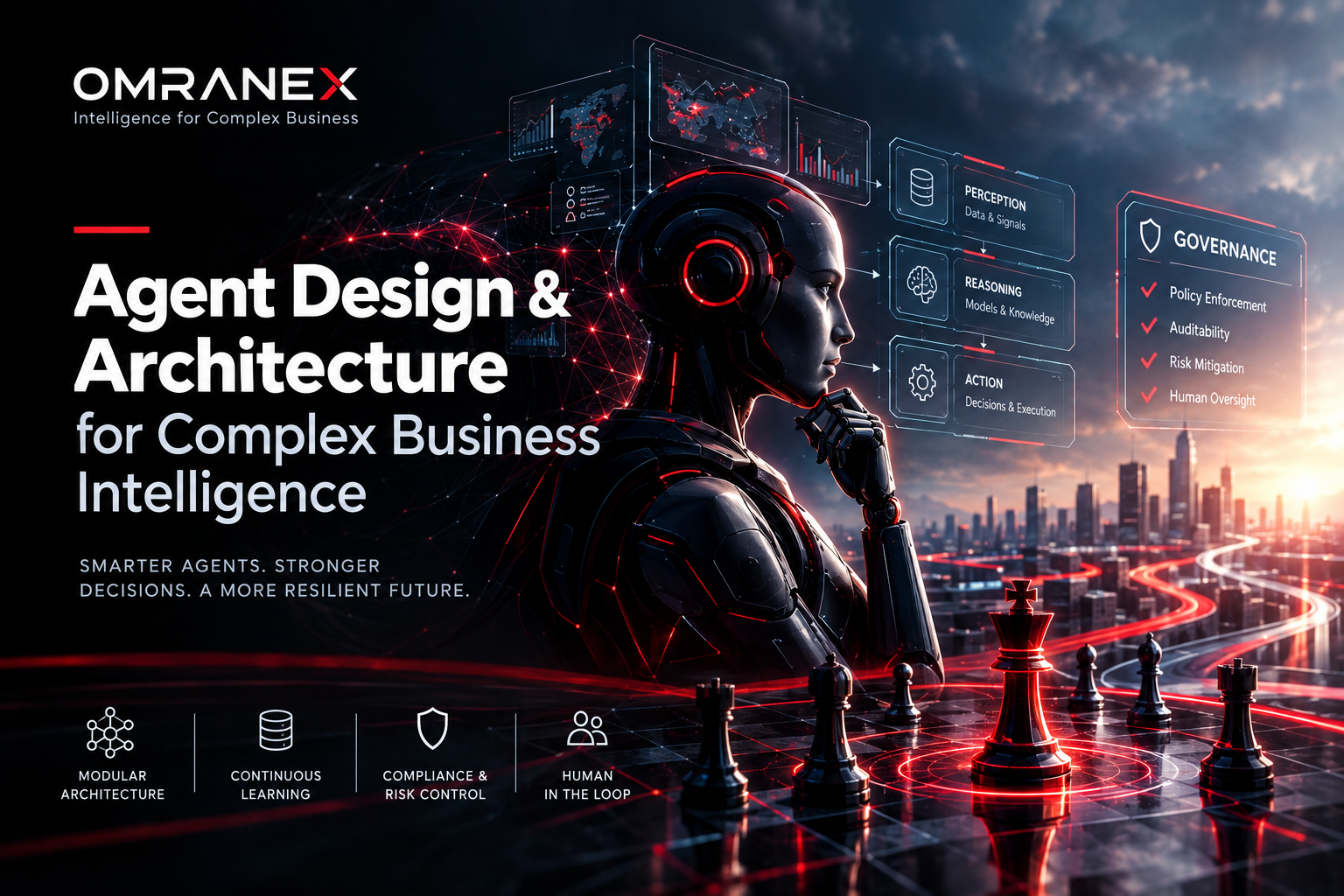
Modular architecture is essential for scalability and maintainability. A layered design separates perception, reasoning, and action, allowing each layer to evolve independently. The following patterns are widely applicable:
- Hierarchical decomposition – break the business problem into sub‑problems that can be solved by specialized sub‑agents.
- Decentralized coordination – employ message‑bus or event‑driven communication to allow autonomous agents to collaborate without a single point of failure.
- Plug‑and‑play knowledge modules – isolate data sources, model training pipelines, and inference engines so they can be updated or swapped without disrupting the whole system.
- Explainability gateways – inject transparent reasoning traces at critical decision points to satisfy audit requirements and build stakeholder trust.
These patterns collectively support an agent that can scale across domains, integrate new information, and be inspected at any level of the decision chain. The architecture should also embed continuous learning loops, where performance metrics feed back into model retraining schedules, ensuring that the agent remains aligned with evolving business conditions.
Governance and Control
Intelligence without governance is a risk. Effective control mechanisms consist of three pillars: policy enforcement, auditability, and risk mitigation. Policy enforcement can be implemented as a policy engine that evaluates each proposed action against a rule base derived from regulatory requirements and corporate risk appetite. Auditability is achieved through immutable logs that capture inputs, reasoning steps, and outputs, enabling retrospective analysis and compliance verification. Risk mitigation includes guardrails such as confidence thresholds, fallback strategies, and human‑in‑the‑loop overrides that prevent the agent from operating outside acceptable bounds.
Intelligence in complex domains is not a static model but a governed, adaptive process that must balance autonomy with accountability.Governance frameworks should be revisited periodically, reflecting changes in the operating environment, new data privacy laws, or shifts in strategic priorities. Embedding governance directly into the agent’s architecture, rather than layering it as an afterthought, reduces latency in decision making and ensures that compliance is a native property of the system.
Implementation Lifecycle
Deploying an intelligent agent is an iterative endeavor. The lifecycle begins with a requirements elicitation phase that translates business objectives into functional specifications. This is followed by a prototype development sprint where a minimal viable agent is built to test core assumptions. Validation activities include unit testing of reasoning modules, simulation of edge cases, and stakeholder review sessions to confirm alignment with domain expertise. Once validated, the agent enters a production environment under a phased rollout, with monitoring dashboards that track key performance indicators such as decision accuracy, latency, and compliance violations.
Post‑deployment, the agent must be continuously observed for concept drift and performance degradation. Automated drift detection algorithms can flag when input distributions diverge from training data, prompting a retraining cycle. Human oversight teams review anomalous decisions, feeding insights back into the policy engine and knowledge modules. This closed‑loop approach ensures that the agent remains both effective and trustworthy over its operational lifespan.
The OMRANEX Perspective
OMRANEX views agent design and architecture as a discipline that intertwines technical rigor with governance. Complexity demands a deep understanding of domain dynamics, while uncertainty requires adaptive reasoning mechanisms that can evolve without compromising control. Intelligence, therefore, is not merely the ability to process data but the capacity to make decisions that are transparent, auditable, and aligned with strategic intent. OMRANEX advocates for a structured, modular architecture that embeds governance at each layer, supports continuous learning, and provides clear pathways for human oversight. By adhering to these principles, organizations can harness autonomous agents as reliable partners in navigating the inherent challenges of complex business environments.