Business Impact of AI Agents: Structured Analysis for Complex Enterprises
AI agents reshape enterprise operations by automating routine tasks, enhancing decision quality, and managing risk, but their true value emerges through disciplined governance and alignment with strategic complexity.
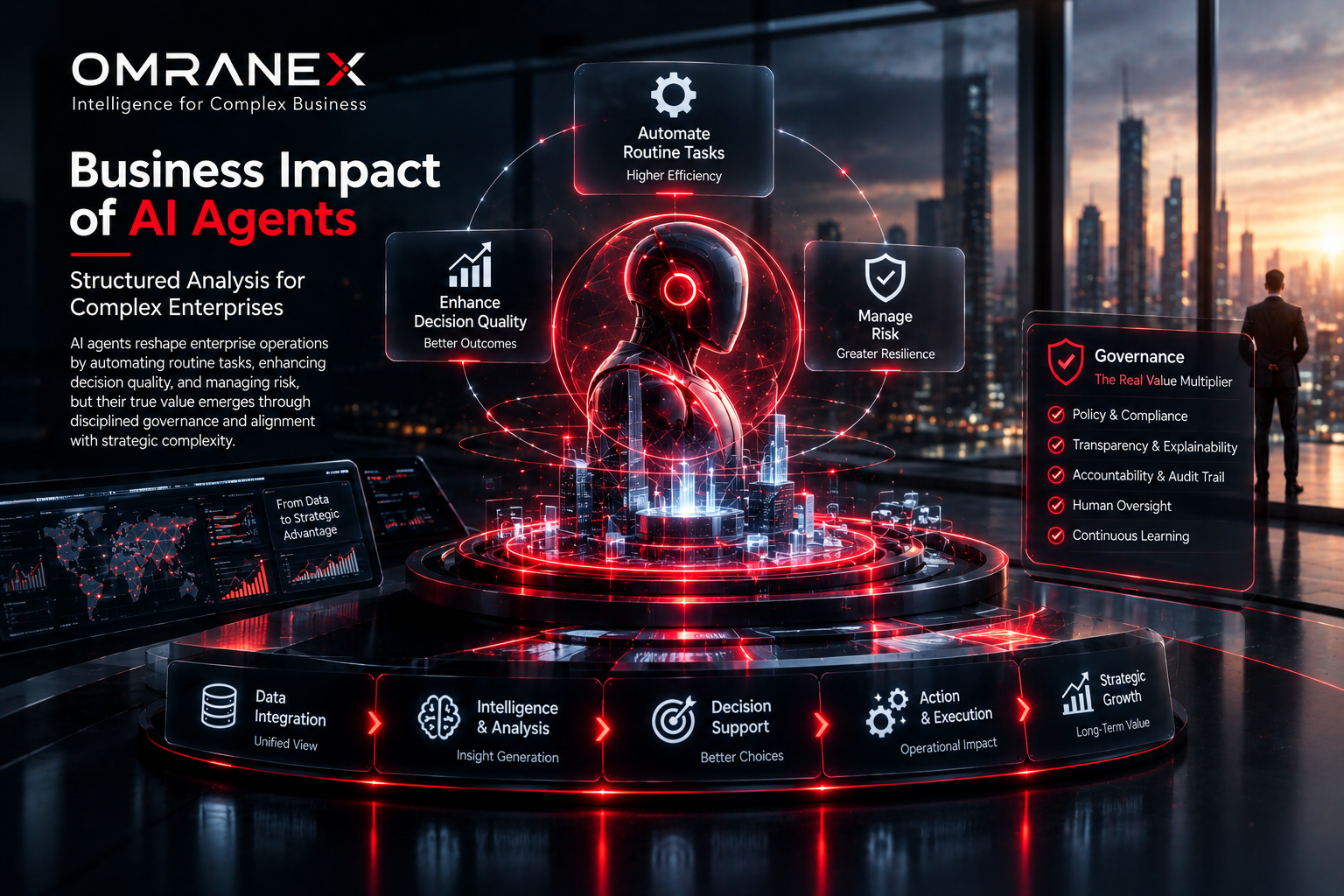
The modern enterprise confronts a persistent dilemma: increasing operational complexity, volatile market conditions, and regulatory scrutiny demand faster, more precise responses. Traditional analytical tools and static automation cannot keep pace with the dynamic interdependencies that define today’s business ecosystems. AI agents—autonomous software entities that perceive, reason, and act within defined domains‑offer a mechanism to inject adaptive intelligence into these environments. However, the business impact of AI agents extends beyond mere efficiency gains; it reshapes decision architectures, risk profiles, and governance frameworks. Understanding this impact requires a systematic examination of how agents integrate, what measurable outcomes they deliver, and how organizations must evolve to govern them effectively.
Defining AI Agents and Their Operational Role
AI agents are software components that combine perception (data ingestion), cognition (contextual reasoning), and actuation (action execution) within a bounded scope. Unlike monolithic models or rule‑based scripts, agents maintain state, learn from interactions, and can operate across multiple touchpoints—for example, coordinating supply‑chain adjustments, customer support escalations, and compliance monitoring simultaneously. Their autonomy is conditional, relying on predefined objectives and governance policies. Consequently, agents function as force multipliers: they amplify existing processes rather than replace them, and they generate continuous feedback loops that refine performance over time.
Quantifying Business Impact: Efficiency, Decision Quality, and Risk Management
The tangible impact of AI agents can be measured across three dimensions:
- Operational Efficiency: Reduction in manual processing time, lower error rates, and optimized resource allocation.
- Decision Quality: Enhanced accuracy in predictive insights, faster identification of anomalies, and improved scenario modeling.
- Risk Mitigation: Proactive detection of compliance breaches, dynamic exposure monitoring, and automated incident response.
Organizations that have deployed agentic systems report average cost reductions of 15‑30% in high‑volume processes and decision‑making latency drops of up to 70%. However, these gains are contingent on data quality, integration fidelity, and the clarity of agent objectives. The core insight is that agents do not operate in isolation; they embed within existing workflows, amplifying both strengths and systemic weaknesses.
"AI agents amplify existing processes but do not replace strategic judgment; governance must evolve to ensure that autonomy aligns with enterprise objectives."
Implementation Challenges and Governance Requirements
Deploying AI agents introduces a distinct set of challenges. First, integration complexity arises from heterogeneous data sources and legacy systems, requiring robust middleware and standardized interfaces. Second, accountability becomes ambiguous when multiple agents coordinate; tracing decisions and assigning responsibility demands transparent logging and audit trails. Third, bias and drift can propagate across agent networks, necessitating continuous monitoring and model validation. Governance frameworks must therefore incorporate three pillars: (1) clear ownership and accountability structures, (2) adaptive policy enforcement that can evolve with agent behavior, and (3) continuous verification mechanisms that assess performance against predefined KPIs.
Strategic Integration and Continuous Adaptation
Successful adoption of AI agents is not a one‑time project but a strategic capability. Organizations should adopt a phased approach: pilot agents in low‑risk domains, establish governance baselines, and iteratively scale based on validated outcomes. Cross‑functional collaboration between IT, data science, legal, and business units is essential to align agent objectives with strategic priorities. Moreover, agents must be designed for continuous learning, with mechanisms for feedback integration, A/B testing, and performance benchmarking. This adaptive loop ensures that agents remain relevant as market conditions, regulatory landscapes, and internal processes evolve.
The OMRANEX Perspective
OMRANEX views AI agents as a critical component of intelligence for complex business environments. Complexity demands granular understanding, uncertainty requires adaptive responses, and intelligence must be governed to protect organizational integrity. OMRANEX advocates for a disciplined, governance‑first approach that treats agents as extensions of enterprise cognition rather than black‑box automatons. This perspective emphasizes measurable impact, transparent accountability, and continuous adaptation as the pillars for sustainable value creation. By embedding OMRANEX’s analytical framework, enterprises can harness AI agents to navigate complexity, mitigate risk, and maintain strategic agility in an ever‑changing landscape.