From Marketing Intelligence to Customer Intelligence: The Role of AI Agents
Marketing Intelligence provides raw data, but Customer Intelligence transforms it into actionable understanding. AI agents synthesize disparate signals, enabling precise customer insights and adaptive decision‑making under uncertainty.
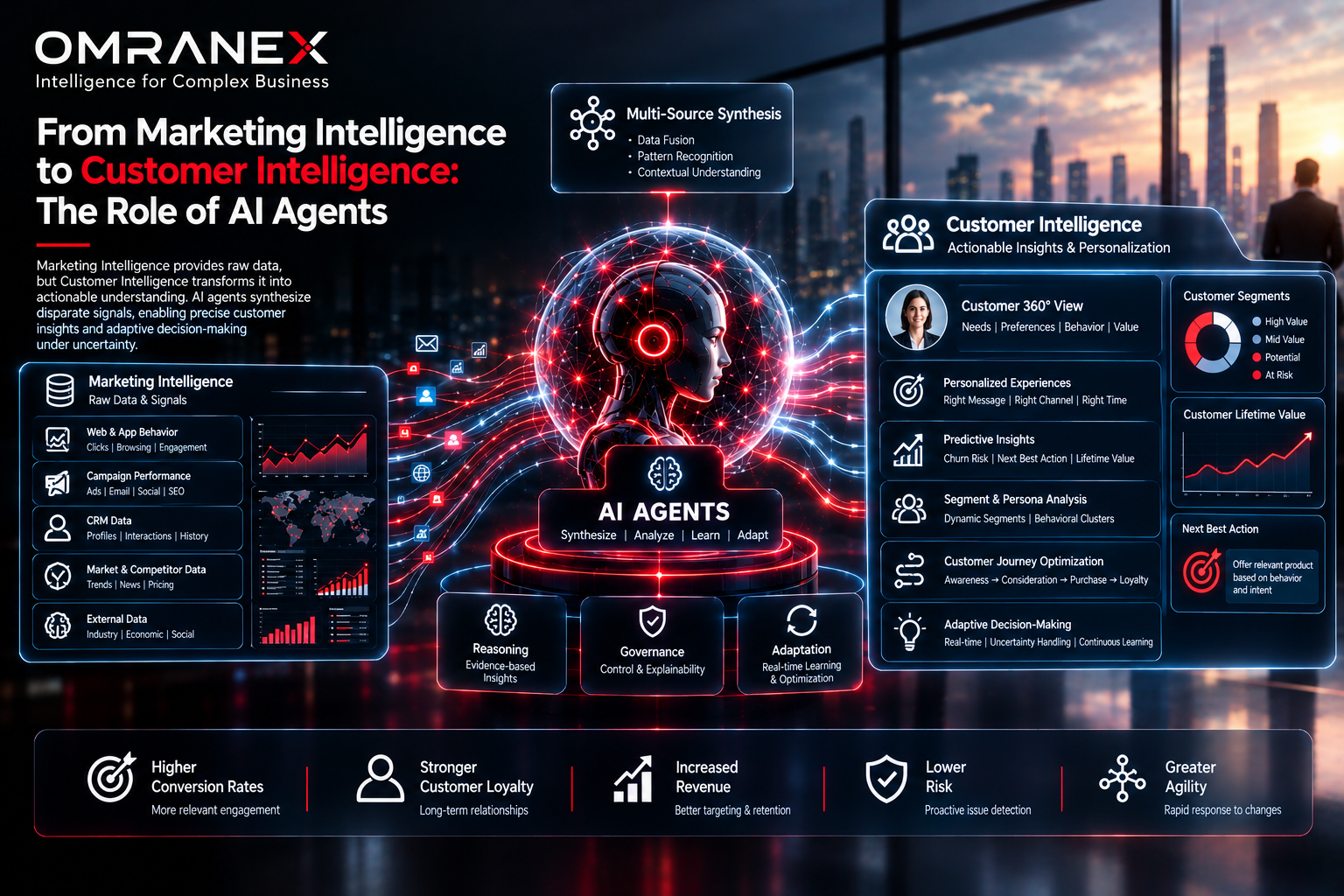
Organizations accumulate extensive marketing data sets, yet the conversion of these repositories into reliable, decision‑ready intelligence remains a persistent bottleneck. The core business problem is not the scarcity of data but the inability to reconcile heterogeneous sources, manage signal noise, and align insights with strategic objectives. In environments characterized by rapid product cycles, multi‑channel touchpoints, and evolving regulatory constraints, the gap between data availability and actionable understanding directly impacts revenue generation, customer retention, and operational efficiency. This analysis examines how AI agents bridge that gap, moving from generic Marketing Intelligence to nuanced Customer Intelligence that supports complex business dynamics.
1. Limits of Traditional Marketing Intelligence
Traditional Marketing Intelligence typically relies on descriptive analytics, dashboard visualizations, and periodic reporting. These approaches excel at summarizing historical performance but fall short in several critical dimensions:
- They treat data sources as independent silos, ignoring cross‑channel interdependencies.
- They lack mechanisms to detect emergent patterns or anomalous behavior in real time.
- They provide static insights that quickly become outdated in fast‑changing markets.
- They require manual interpretation, introducing latency and human bias.
Consequently, strategic decisions often rest on incomplete or delayed information, increasing the risk of mis‑allocation of marketing spend and missed opportunities for personalization.
2. Architecture of AI Marketing Agents
AI Marketing Agents are autonomous software entities that combine data ingestion, contextual modeling, and decision support into a cohesive workflow. Their architecture can be decomposed into five functional layers:
- Data Integration Layer: Consolidates structured and unstructured inputs from CRM, web analytics, social listening, and external market feeds using event‑driven pipelines.
- Signal Processing Layer: Applies time‑series forecasting, anomaly detection, and natural‑language understanding to extract meaningful signals from noise.
- Context Modeling Layer: Constructs a unified customer profile that maps behavioral, demographic, and psychographic attributes across the entire journey.
- Insight Generation Layer: Utilizes causal inference and reinforcement learning to predict the impact of marketing actions under uncertainty.
- Decision Support Layer: Provides scenario simulations, recommendation engines, and governance controls that enable human strategists to validate and execute actions.
These layers operate iteratively, allowing the agents to adapt as new data arrives and as business objectives evolve.
3. From Data to Insight: Customer Intelligence Workflow
The transformation from raw data to actionable Customer Intelligence follows a structured workflow that emphasizes governance and reproducibility:
- Data Ingestion and Validation: Automated connectors pull data from internal systems and third‑party providers, applying schema normalization and quality checks.
- Feature Engineering: Domain‑specific features such as engagement propensity, churn risk, and lifetime value potential are derived using advanced statistical techniques.
- Model Training and Validation: Machine‑learning models are trained on historical interactions, with cross‑validation and fairness audits to ensure robustness.
- Real‑Time Scoring: The trained models generate scores and predictions at inference time, feeding into recommendation engines and campaign optimization tools.
- Feedback Loop: Observed outcomes are fed back into the system, updating models and refining the customer understanding over time.
Throughout this workflow, audit trails and version controls maintain transparency, satisfying both internal compliance requirements and external regulatory expectations.
The true value of AI agents lies not in speed of analysis but in their ability to reconcile conflicting signals and surface latent patterns that human analysts cannot see.
4. Governance and Adaptation in Complex Environments
Complexity introduces uncertainty, and uncertainty demands governance. Effective Customer Intelligence systems embed governance at multiple levels:
- Policy Enforcement: Role‑based access controls and data‑usage policies ensure that only authorized personnel can view or modify sensitive customer data.
- Model Explainability: Interpretable AI techniques provide rationale for predictions, enabling stakeholders to understand the basis for recommendations.
- Continuous Monitoring: