From Target Market Selection to Competitive Intelligence: AI Agents in B2B Strategy
AI agents transform B2B competitive intelligence by automating market scanning, competitor positioning analysis, and strategic advantage identification. This article outlines how intelligent automation supports target market selection and continuous competitive monitoring for data‑driven decision making.
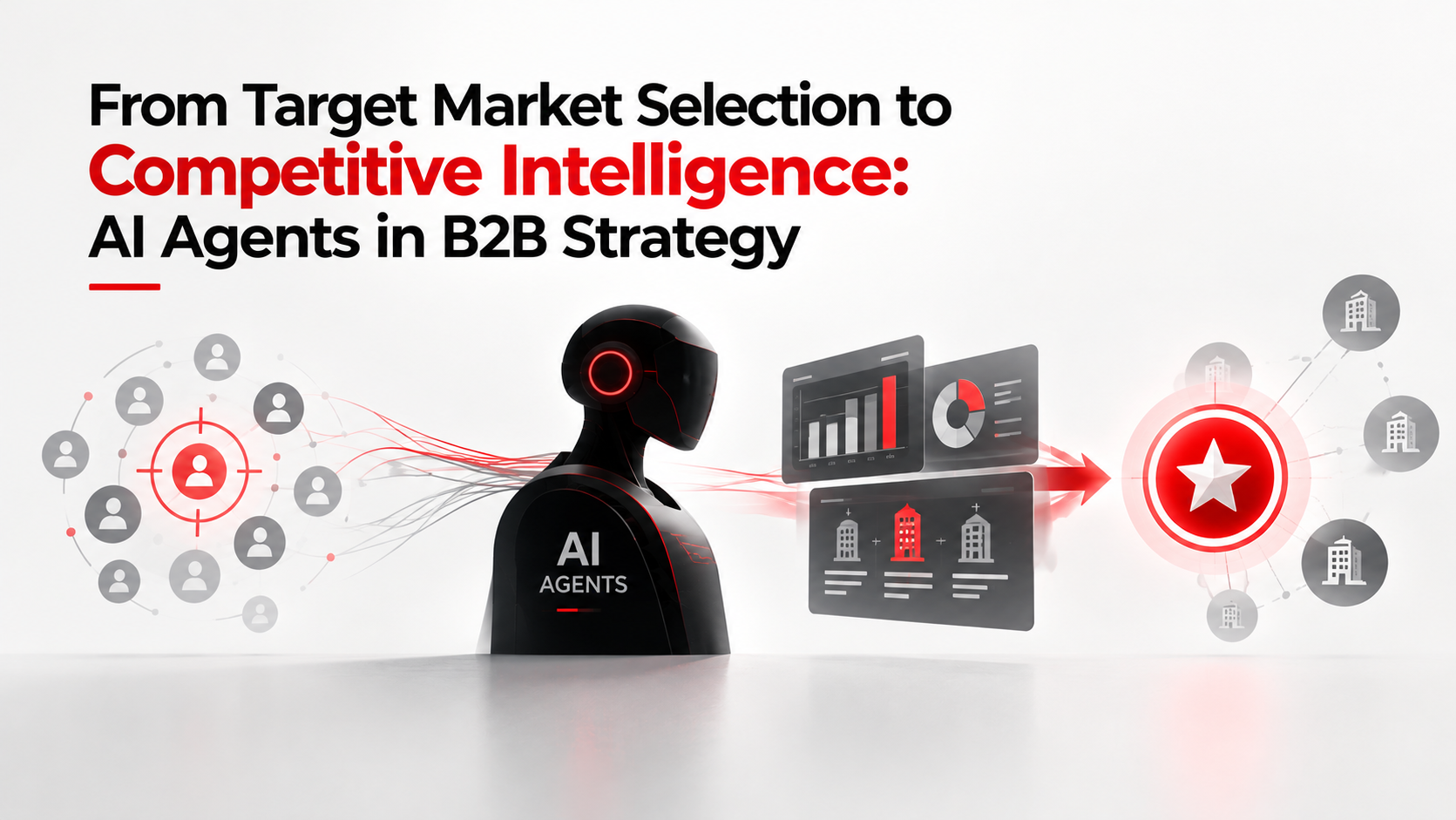
Business leaders operating in complex B2B environments face a persistent challenge: the gap between abundant market data and actionable strategic insight. Traditional competitive intelligence processes rely on manual data collection, periodic reporting, and subjective interpretation, which cannot keep pace with the velocity and volume of competitor activity, customer behavior shifts, and emerging market dynamics. The real problem is not the lack of information but the inability to transform that information into timely, governance‑aligned advantages that sustain differentiation and growth.
The Evolving Scope of Competitive Intelligence in B2B Markets
Competitive intelligence in B2B contexts has moved beyond simple SWOT analyses and static benchmarking. Modern markets are characterized by multi‑layered stakeholder ecosystems, intertwined value chains, and rapid technological disruption. As a result, intelligence must address three dimensions simultaneously: (1) macro‑level market forces that shape demand, (2) micro‑level competitor actions that affect positioning, and (3) internal capabilities that determine response readiness. This tripartite demand creates inherent uncertainty and complexity, requiring a systematic, repeatable, and auditable approach to information gathering and analysis.
The traditional intelligence cycle—collection, processing, analysis, and dissemination—remains relevant, but its execution must be augmented with automated data ingestion, real‑time processing, and adaptive learning. Without such augmentation, organizations risk decision latency, blind spots, and strategic drift.
AI Marketing Agents as Operational Enablers
AI marketing agents are autonomous software entities that combine natural‑language processing, graph analytics, and predictive modeling to perform continuous competitive monitoring. Their operational value lies in three core capabilities:
- Cross‑source data aggregation from public filings, patent databases, social media, industry reports, and proprietary customer insights.
- Real‑time sentiment and narrative analysis to detect shifts in competitor messaging, product positioning, or market claims.
- Dynamic competitive mapping that updates product feature sets, pricing structures, and go‑to‑market tactics as new data arrives.
These agents are not black‑box predictors; they embed governance through transparent rule sets, audit trails, and human‑in‑the‑loop validation. By coupling autonomy with oversight, they deliver intelligence that is both scalable and trustworthy.
AI agents do not replace human judgment; they amplify it by delivering actionable intelligence at scale and speed.
The deployment of agents typically follows a phased rollout: (1) define data taxonomies and quality thresholds, (2) configure extraction rules for each competitor’s digital footprint, (3) train classification models on historical intelligence, and (4) establish alert thresholds and escalation pathways. This structured approach ensures that the system remains aligned with strategic objectives while adapting to evolving market conditions.
From Target Market Selection to Competitive Positioning
One of the most direct applications of AI agents is the support of target market selection and subsequent competitive positioning. Agents can ingest segment‑level data—firmographics, purchasing patterns, pain points—and overlay competitor presence matrices to identify underserved niches or emerging opportunities. The resulting insight enables marketers to prioritize segments where differentiation potential is highest.
Once a segment is selected, agents generate a dynamic competitive positioning report that includes:
- Feature‑level comparisons derived from product documentation and customer reviews.
- Pricing elasticity indicators based on historical discount patterns and market reactions.
- Messaging resonance scores that reflect how competitor narratives are received by target audiences.
These dimensions feed directly into positioning strategies, allowing organizations to craft value propositions that are both distinct and compelling. The continuous nature of agentic monitoring ensures that positioning remains relevant as competitors adjust their tactics.
Implementation Considerations and Governance
Deploying AI agents for competitive intelligence requires attention to several operational factors:
- Data provenance and quality assurance to prevent bias from incomplete or erroneous sources.
- Model interpretability to satisfy legal and compliance requirements, especially in regulated industries.
- Escalation protocols that define when human analysts should intervene, preserving accountability.
- Integration with existing CRM, PLM, and analytics platforms to avoid data silos and ensure unified decision support.
Governance frameworks should embed risk assessment, privacy compliance, and ethical use guidelines. Regular audits of agent outputs, coupled with periodic model retraining, maintain relevance and mitigate drift.
The OMRANEX Perspective
OMRANEX recognizes that complexity demands understanding, uncertainty demands adaptation, and intelligence demands governance. Our platform provides a robust, agentic AI ecosystem that automates the end‑to‑end competitive intelligence workflow while preserving human oversight and ethical standards. By unifying data ingestion, real‑time analysis, and strategic reporting, OMRANEX enables B2B organizations to convert market complexity into measurable competitive advantage, ensuring that strategic decisions are both informed and defensible.