From ICP to Target Market Selection: How AI Agents Navigate Market Complexity
AI agents turn vast data into precise market intelligence, linking Ideal Customer Profiles with measurable attractiveness to guide B2B target selection under uncertainty.
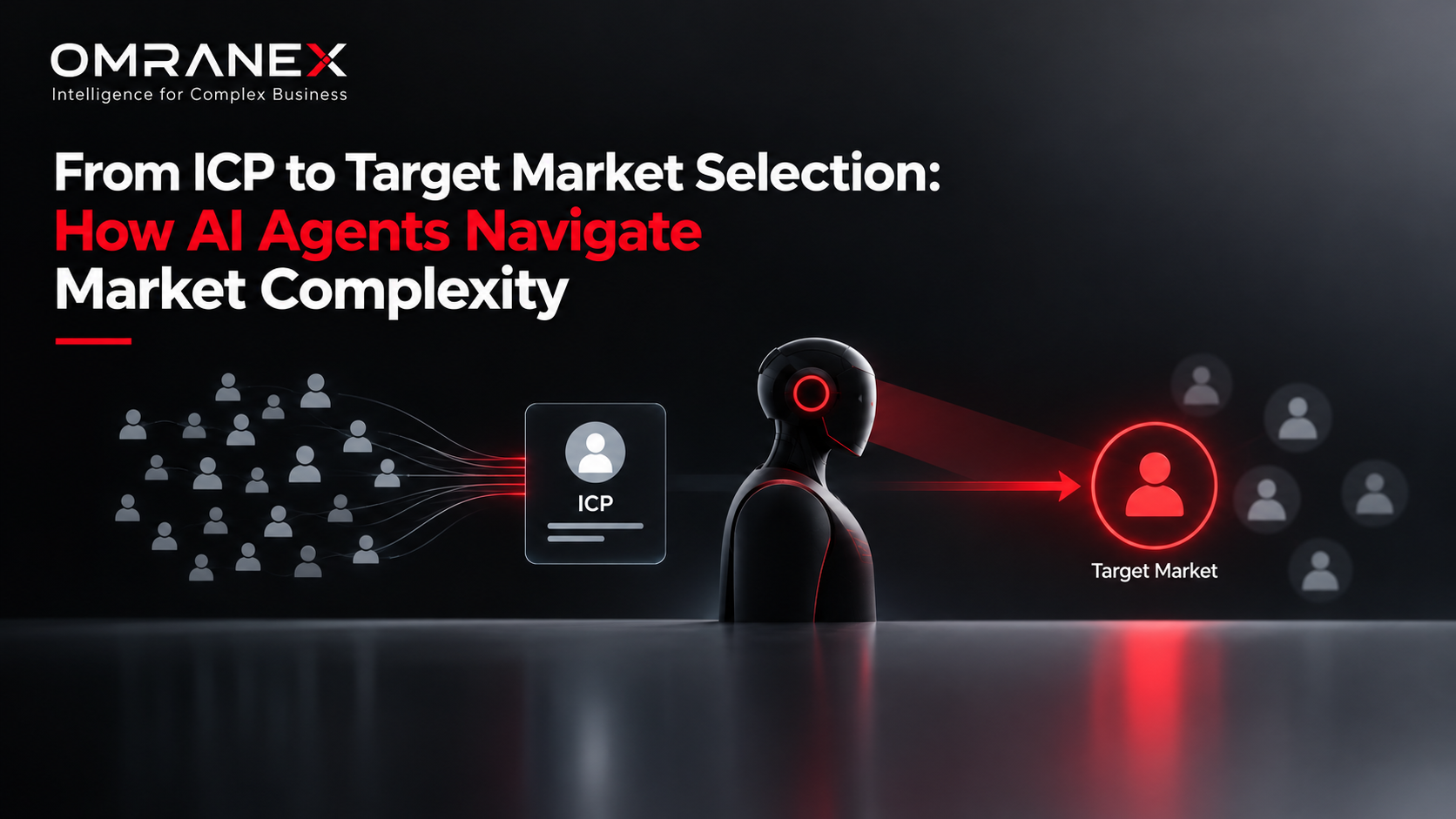
The challenge of selecting a target market in modern B2B environments extends beyond traditional segmentation. Companies face an influx of signals—firmographic, behavioral, and competitive—while operating in markets where customer needs evolve rapidly. Decision makers require a systematic method to transform Ideal Customer Profiles (ICPs) into actionable market choices without sacrificing rigor or governance. This analysis examines how AI agents and market intelligence platforms bridge that gap, delivering data‑driven insights that are both comprehensive and controllable.
Foundations of Market Intelligence and AI Agents
Market intelligence in a complex B2B context comprises three core components: data acquisition, contextual analysis, and decision support. AI agents excel at orchestrating these components by ingesting heterogeneous data sources—CRM records, web analytics, third‑party databases, and social listening feeds—and normalizing them into a unified view. The agents then apply natural language processing, graph analytics, and statistical modeling to surface patterns that align with the organization’s ICP definitions. The result is a living intelligence layer that continuously updates the understanding of who the ideal customer is and where that customer manifests across geographic, industry, and behavioral dimensions.
From Ideal Customer Profiles to Market Segmentation
An Ideal Customer Profile encapsulates demographic, firmographic, technographic, and psychographic attributes that define the most valuable prospect. AI agents extend the static nature of ICPs by dynamically segmenting markets based on real‑time performance indicators. They evaluate each segment against the ICP criteria, assigning a fit score that reflects both attribute alignment and engagement momentum. This approach transforms the ICP from a reference document into an operational engine that can be queried for market depth, growth potential, and competitive density.
"AI agents transform raw market signals into actionable intelligence, enabling precise target market selection while maintaining governance over data quality and decision logic."
Assessing Market Attractiveness with Agentic AI
Selecting a target market requires more than fit; it demands an evaluation of attractiveness. Agentic AI platforms integrate quantitative metrics—such as total addressable market (TAM), growth rate, and concentration ratios—with qualitative factors like buyer sophistication and ecosystem support. The agents run scenario simulations that model the impact of variable changes (e.g., pricing shifts, competitive entry) on revenue projections and risk exposure. The output is a multi‑dimensional attractiveness matrix that surfaces the most promising markets for strategic investment.
Governance and Decision Support in Complex Environments
Complexity introduces risk. Effective governance ensures that AI‑driven insights remain transparent, auditable, and aligned with corporate policy. Governance frameworks should cover data provenance, model validation, and human oversight loops. Decision support tools embed explainability features, allowing strategists to interrogate why a particular market received a high attractiveness score. By coupling autonomous agent activity with structured review checkpoints, organizations preserve control while leveraging the speed and scalability of AI.
- Real‑time ingestion of structured and unstructured market data.
- Automated ICP alignment scoring across multiple segment dimensions.
- Dynamic market segmentation that updates as signals change.
- Predictive modeling of market attractiveness incorporating financial and competitive variables.
- Explainable AI outputs that trace each recommendation to underlying data and logic.
- Continuous learning loops that refine agent behavior based on observed outcomes.
The OMRANEX Perspective
OMRANEX recognizes that the modern B2B landscape is defined by intertwined data streams, shifting buyer behaviors, and heightened competitive pressure. Complexity demands a deeper understanding of market dynamics, uncertainty necessitates adaptive strategies, and intelligence must be exercised within robust governance structures. Our ecosystem of AI agents and market intelligence tools is designed to deliver that balance: it transforms raw data into actionable insight, aligns every market decision with the organization’s Ideal Customer Profile, and ensures that decision‑making remains transparent, accountable, and resilient. By embedding governance into the fabric of autonomous analysis, OMRANEX enables leaders to select target markets with confidence, even as the underlying conditions continue to evolve.